

Waterfall Chasing: Return to the Canyon of Five Falls
Field Notes IV.XX: A photo essay about the Canyon of Five Falls on the Chattooga River of North Georgia, May 2026

Welcome to Field Notes!

A human being, though of defined form, is composed mostly of water. Think then, of the sounds of water and how they may intricately adhere to a human’s being.
Delicate musicality from a trickling stream carried across roots and stones. Gentle tapping of raindrops on leaves. Or the deafening silence of mist hovering above frigid still waters of a pond lit by the setting moon. These sounds reflect a deep esoteric stillness within us.
The sound of water is also the crack of thunder in perilous clouds overhead. The din of a torrential downpour hammering the earth, transformed by lightning flash into the pelting thuds of hail. The violence of those sounds infuses a certain lucidity that forever hones our vision of the world.
And then, consider water’s roar. The deeply resonant growling of a river careening through a boulder choked notch between precipitous hillsides covered in primordial forest. The fierce sound of pure aliveness. Of energy. It is a sound more properly felt as the vibrations in one’s chest than heard with the ears.
It is this persistent thundering roar that I heard two years ago in the Canyon of Five Falls on the Chattooga River, forming the border between North Georgia and South Carolina. It is the sound of this water that finds resonance in my spirit. Its echoes have reverberated through my psyche ever since. So now again, I find myself drawn back to the sound of this water.
Two months of worsening drought have been broken by several days of rain. Cloud cover will persist in the day ahead, with possibly storms in the afternoon. These could be the best conditions to be hoped for. There are no trails leading into the canyon. After the closest nearby trail ends progress is dependent on rock hopping downstream, scrambling along the rocky shoreline, and wading to follow the Chattooga downstream past a sharp bend. The series of five rapids lay beyond this bend.
Wetness from the rains will help foliage pop with green vibrancy. Perhaps water levels will be low enough for this route to be passable, while still offering enough flow to see and feel the river’s power.
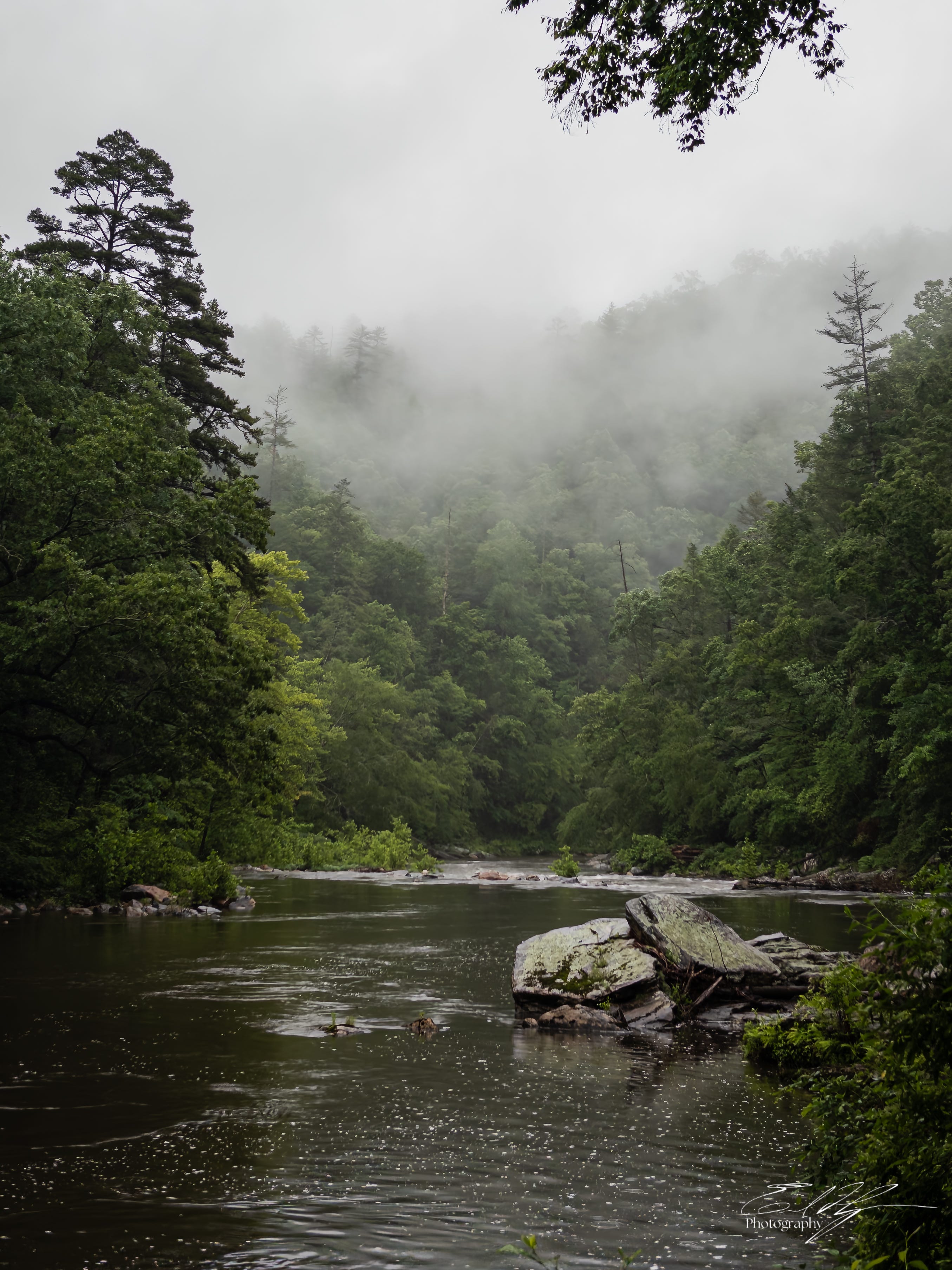
Clouds hang low, gracing the treetops as I arrive at the Chattooga. The forest drips. Humidity thickens the air and its not long before my skin drips. Rich mixed odors of wet leaf mold and of fresh green things saturate the atmosphere. The smell of decay and of rejuvenation. All is silent. My footsteps on the soft earth are silent. Here, before the canyon, the Chattooga’s waters are smooth. Quiet.
I find myself alone. The day is early yet, but I expected to see kayakers. Maybe even fishermen or someone like me, out exploring. There is no one here but me, immersed in the verdant landscape.
The end of the established trail is familiar. I have reached this point several times in the past. The way forward from here is obvious- just follow the riverbank. That does not signify that it is easy.
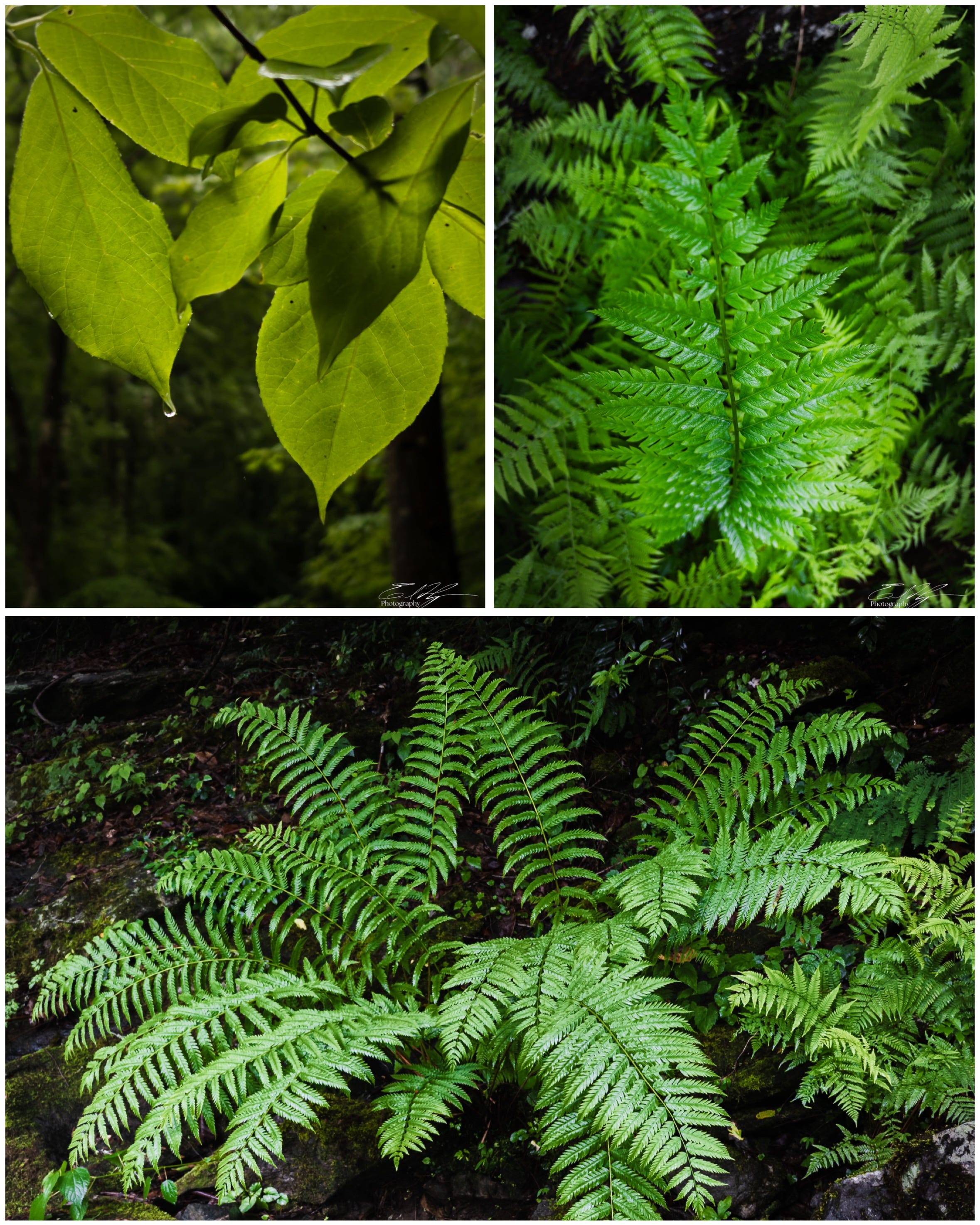
A hint of a path meanders through the stones just above the water’s edge. The last time I followed it was in February, two years ago. Easy to discern at winter’s end. Today it so overgrown with lush foliage it is impossible to see the ground. Dripping fern, yellowroot, jewel weed, and more reach thigh high. Every step is a gamble with stones laying in wait to twist ankles. And, scattered amidst the green are clusters of leaves of three. Poison ivy. Thankfully not very much.
The slope of the hillside grows steeper in proximity to the river bend ahead. There are no more boulders to hop. No more shelf of land to pick my way across. I was prepared to get wet on this route and the time has arrived to walk in the water.
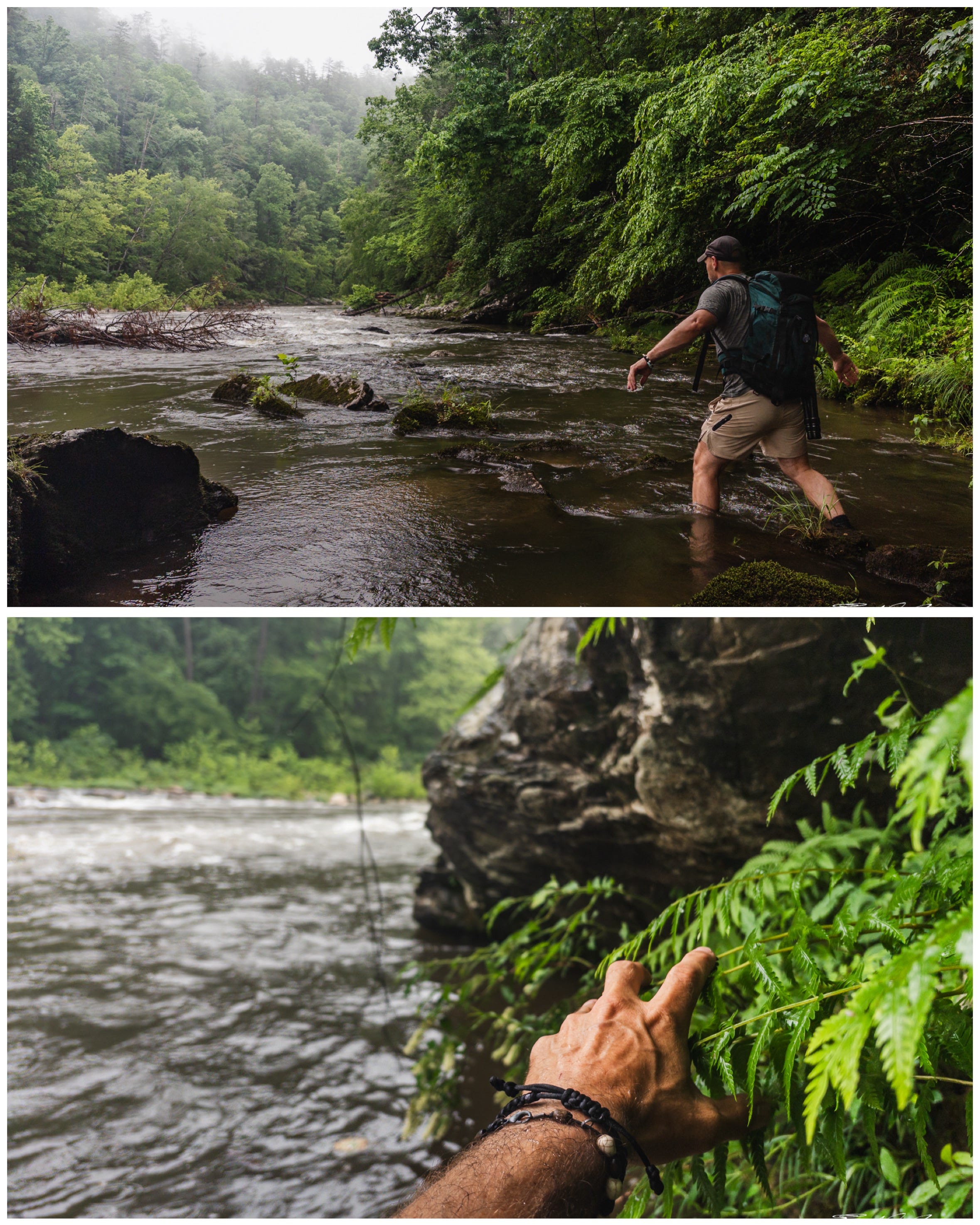
What at first was a faint rumble of rapids grows louder as I maneuver ahead. Walking in the water is easier only in that it avoids the overgrowth. Submerged rocks are ever-present, sharp, and slick.
Before me looms an overhanging rock cliff with a deep pool below. Looking at the pool I have a sense that it is deep, but can’t determine just how deep. This spot has turned me back in the past.
A swim would not harm me. I was resigned to getting wet today, but the camera gear in my pack is sensitive. It is secured in a heavy duty dry sack, but this isn’t designed to be totally submerged. There is no alternate route today; I must try. I step into the pool, up to my knees. An awkward log keeps me further from the rocky edge than I would like. The water reaches my thighs. Then my waist. Now my chest.
Retreat. I have to get closer to the rock face. Bending under the log, a second try clinging to the cliff is the only possibility. The water still rises to my upper chest. Grasping at stone finger holds with my left hand, I hold my pack overhead with my extended right arm, moving ahead by inches. Tricky angles and weight balances pull me backwards towards the watery depths, but I manage to hang on.
At last I can reach over the top of the rock. My pack finds a purchase on top and I am able to scramble around and out of the water. That was it! I’ve crossed the biggest obstacle to reaching the canyon!
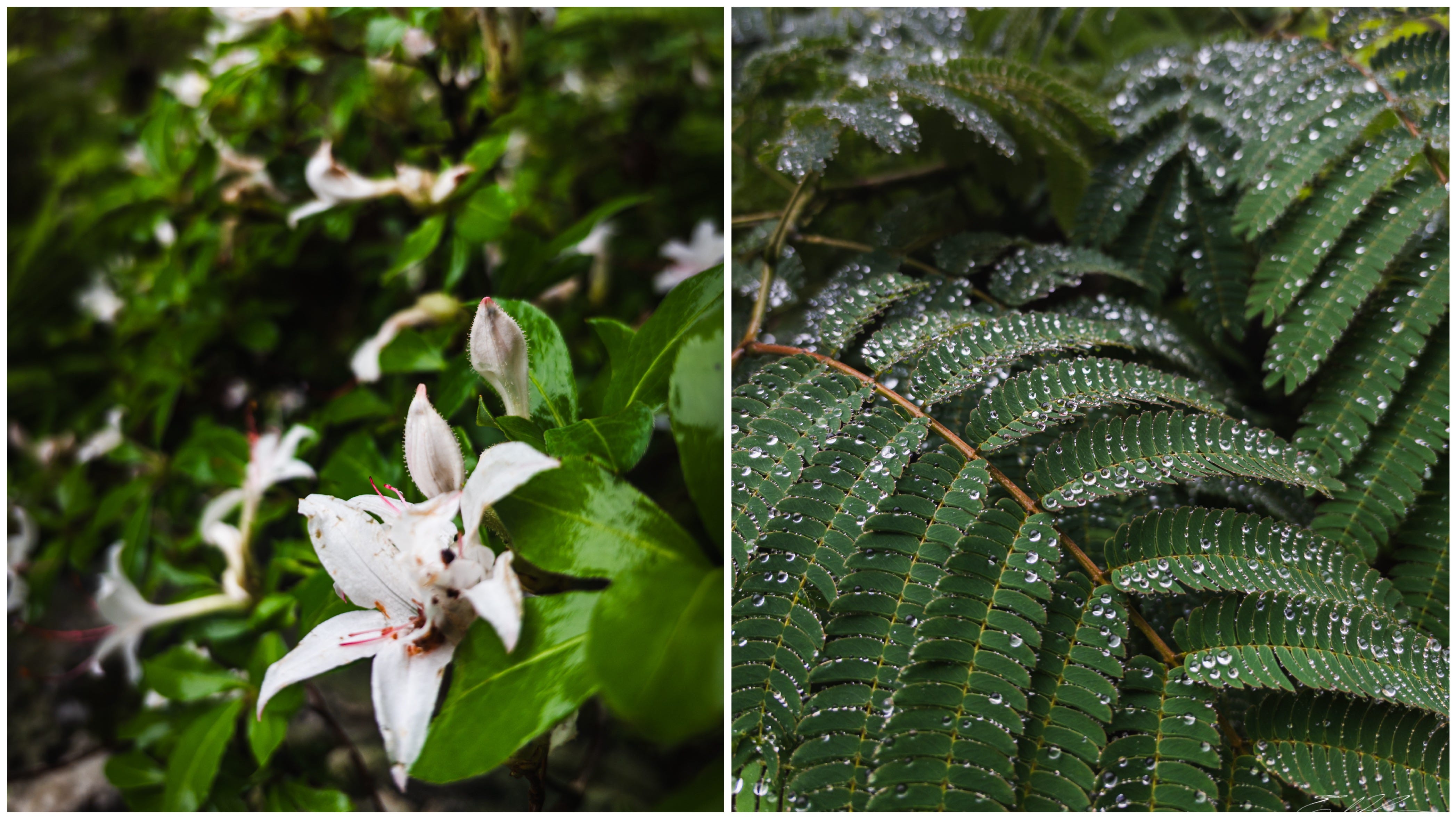
The Chattooga makes its sharp bend to the right. Sandy beeches sprawl amidst the rocks on the shore and it is wider, flatter now. Various flowers bloom in the greenery and beaded water droplets glint like diamonds on delicate new growth.
Azaleas grow here. Most are in full bloom, at varying heights from the shoreline to the hillsides. All around me blush pinkish white blossoms, glistening from rain.
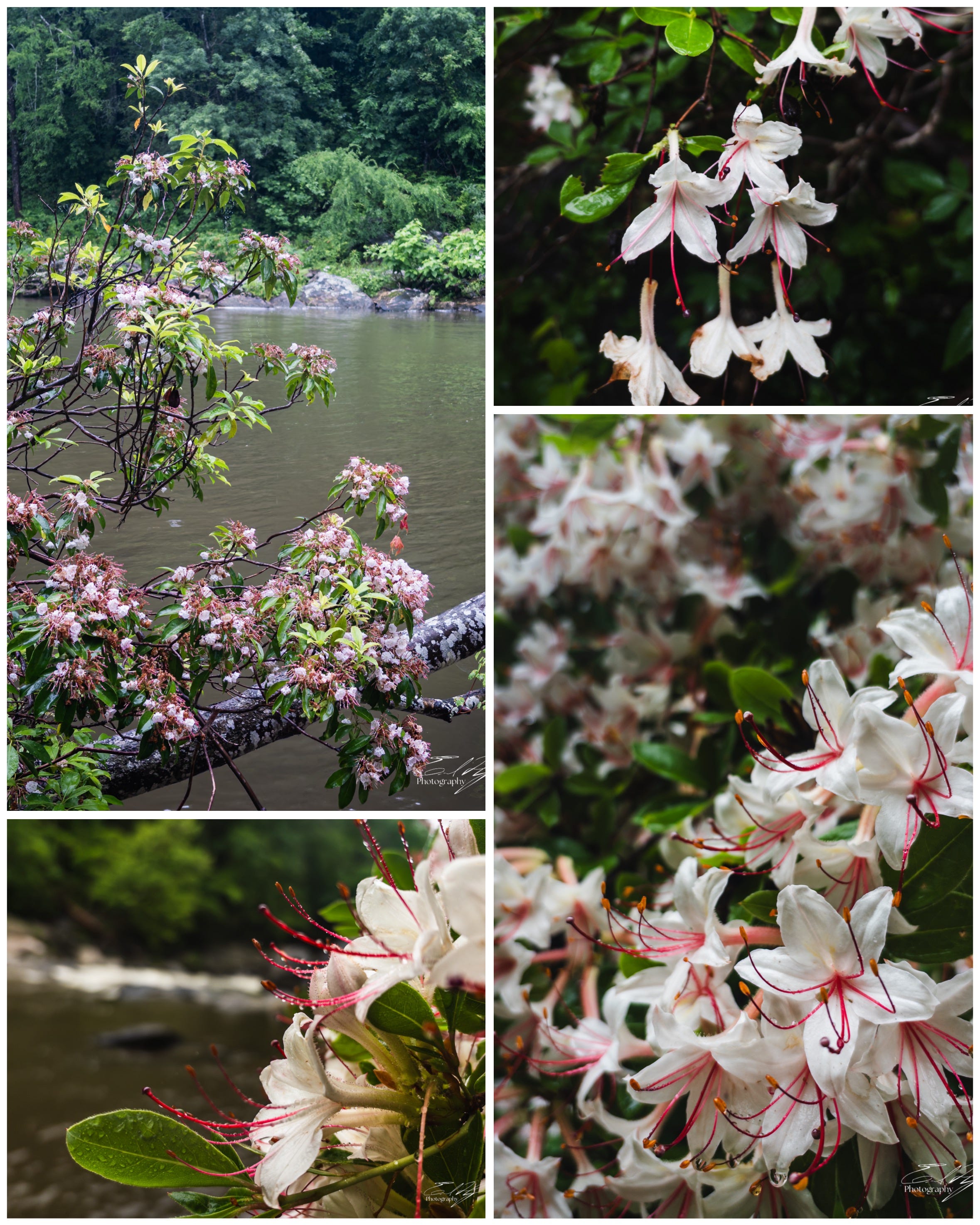

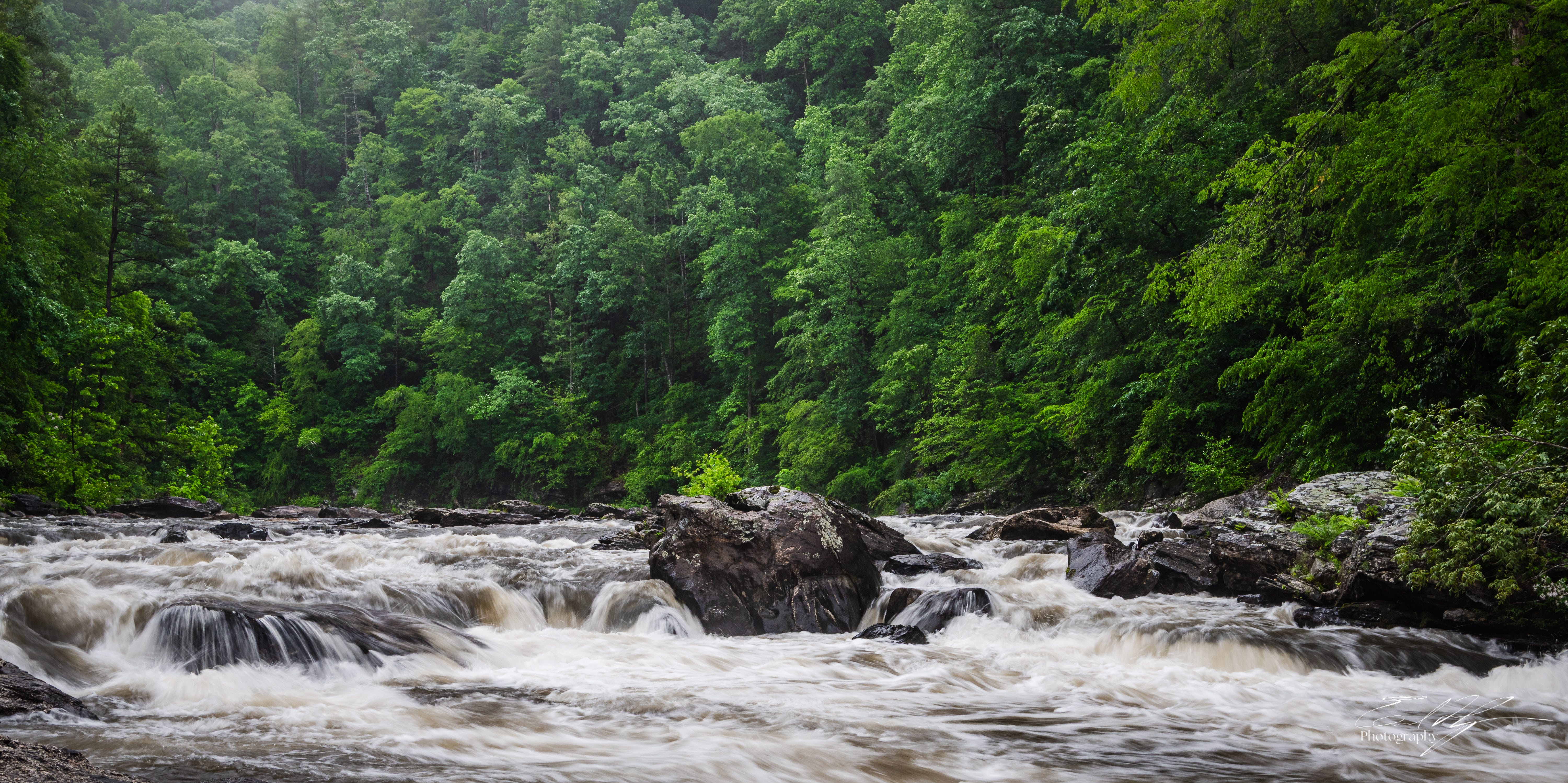
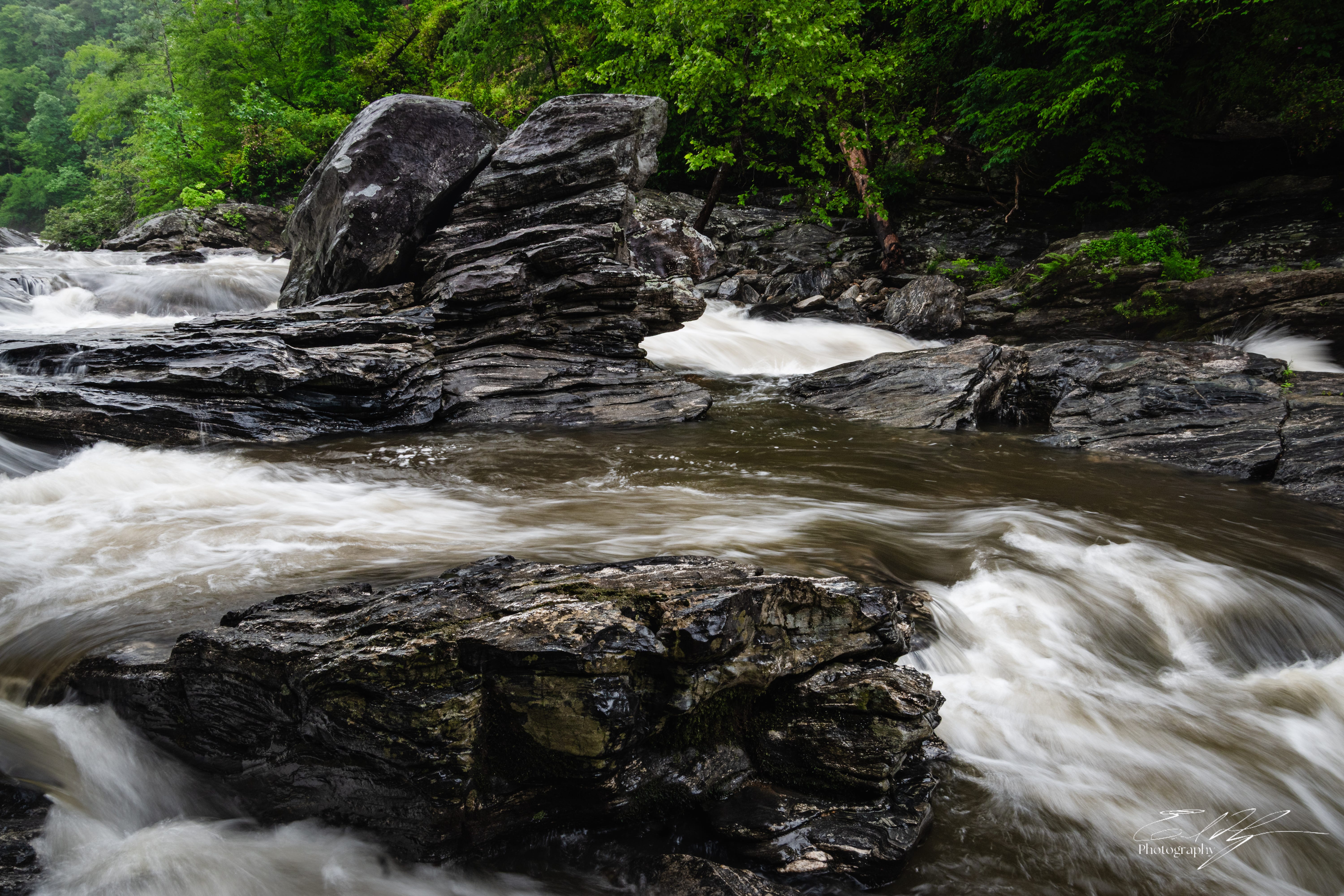
Massive boulders and shelves of rock spring up past the river’s turn. The water is thunderous; intensely loud. Scrambling through rhododendron branches and across stone, I come to the first cascade in the Canyon of Five Falls.
Of the five cascades, I have seen the first two and part of the third before. Climbing all the way down takes a lot of time. My idea for this excursion was to make my way to the bottom and take photographs on my way back up. Now that I see the lay of the canyon, though, I think otherwise.
Starting at the bottom may take too much time. The day may get too late for photographs. Afternoon storms may come. I do not want to be caught here in this remote, inaccessible gorge during thunderstorms.
So, I begin looking at the first rapid, Entrance Cascade. I choose compositions that highlight the water, the intense green above and around it. I make multiple exposures of varying shutter speeds. Some of these are to test which speed captures the flow in the best way. In other photos I will layer different shutter speeds and paint in different speeds of capture into the flow.
Painting with time. How can I learn to capture my own fleeting moments and paint them back into the timeline where I want them?
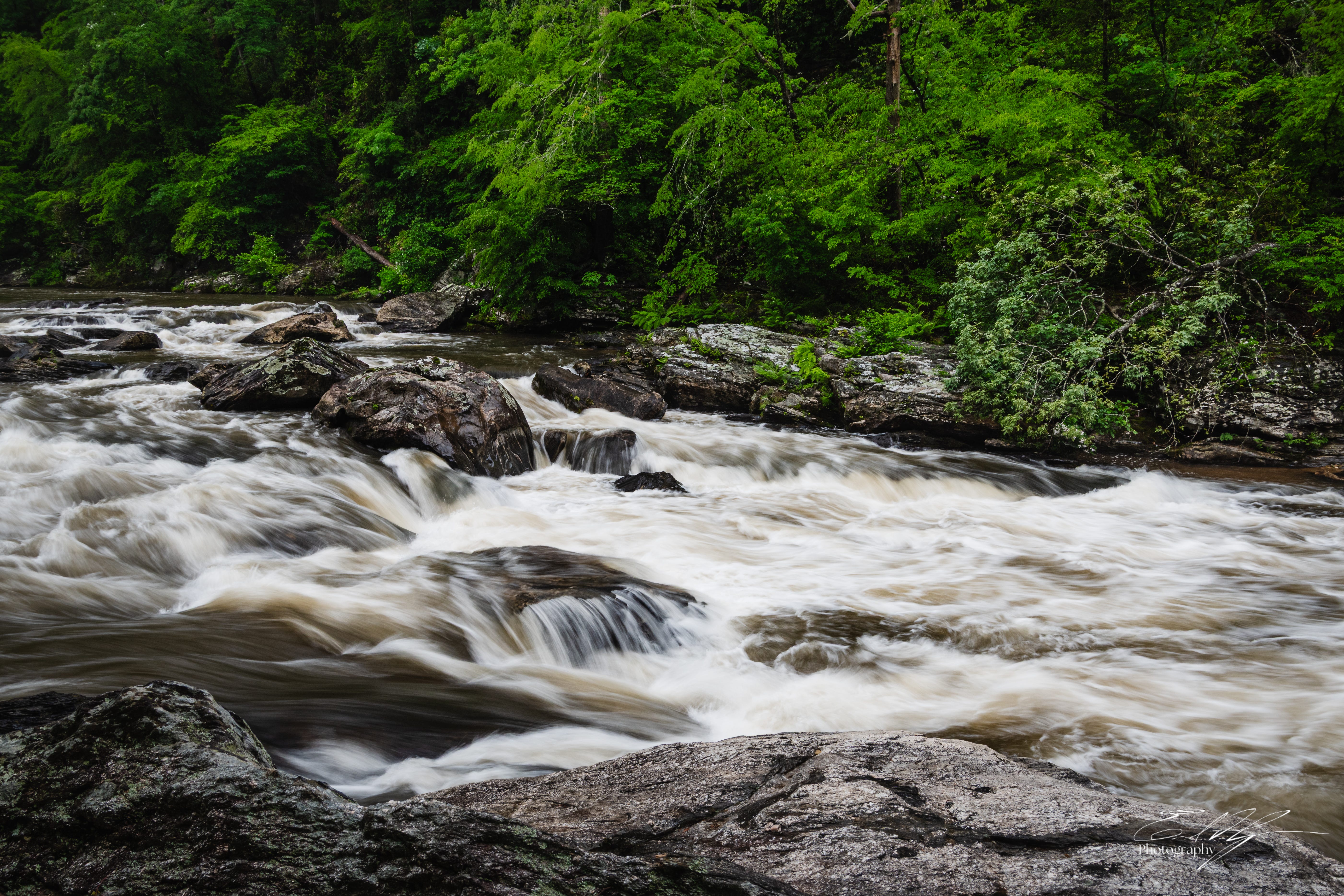
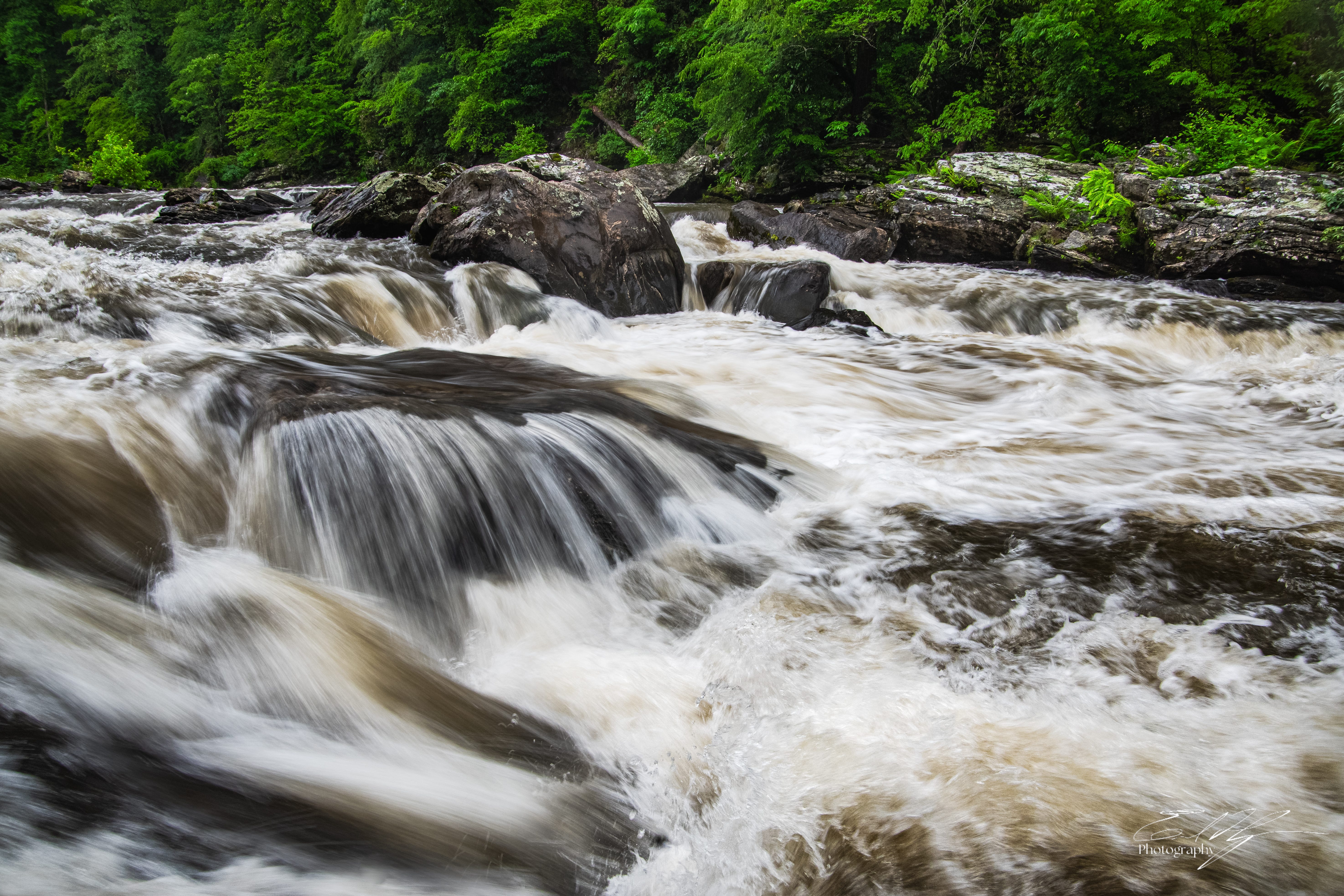
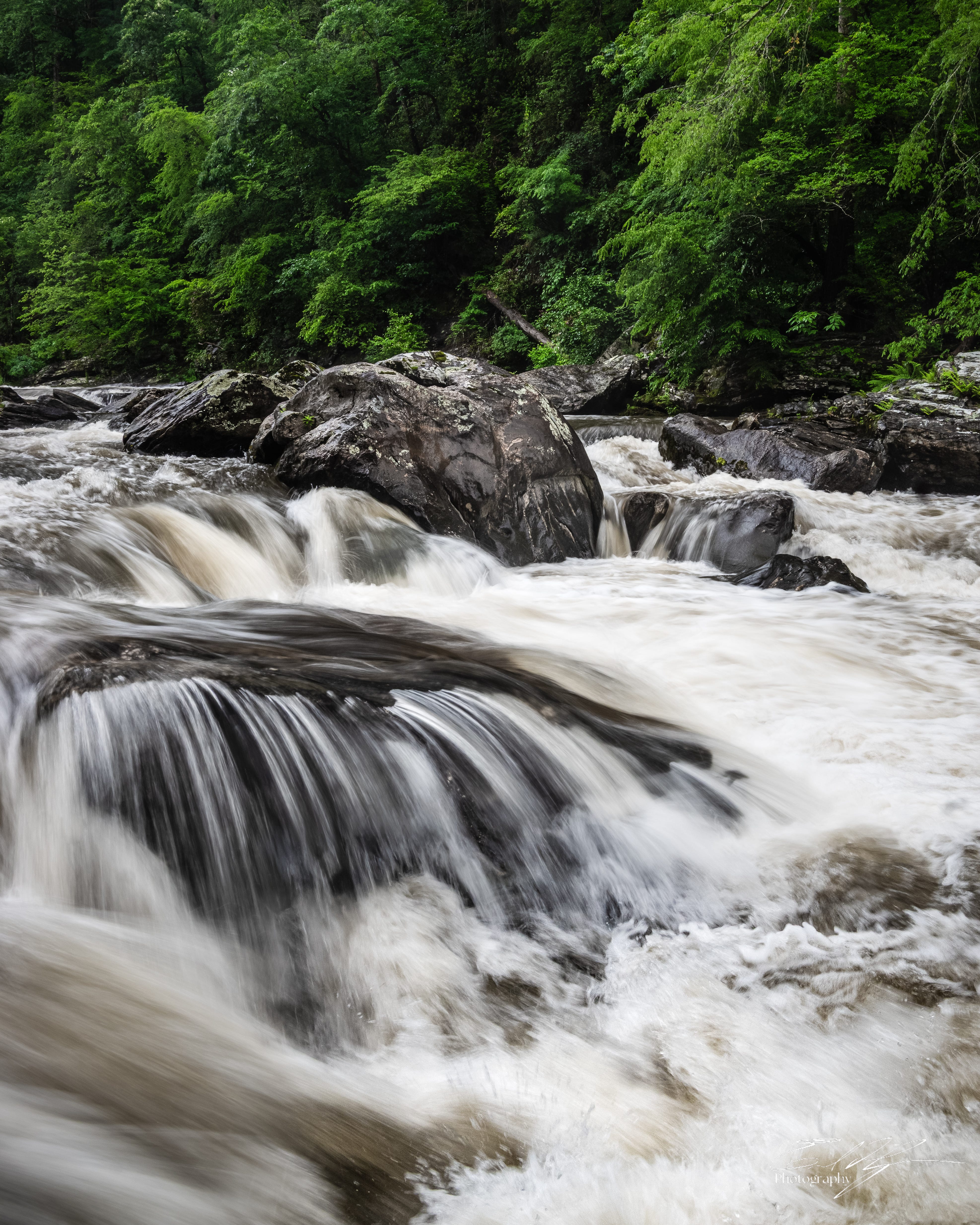
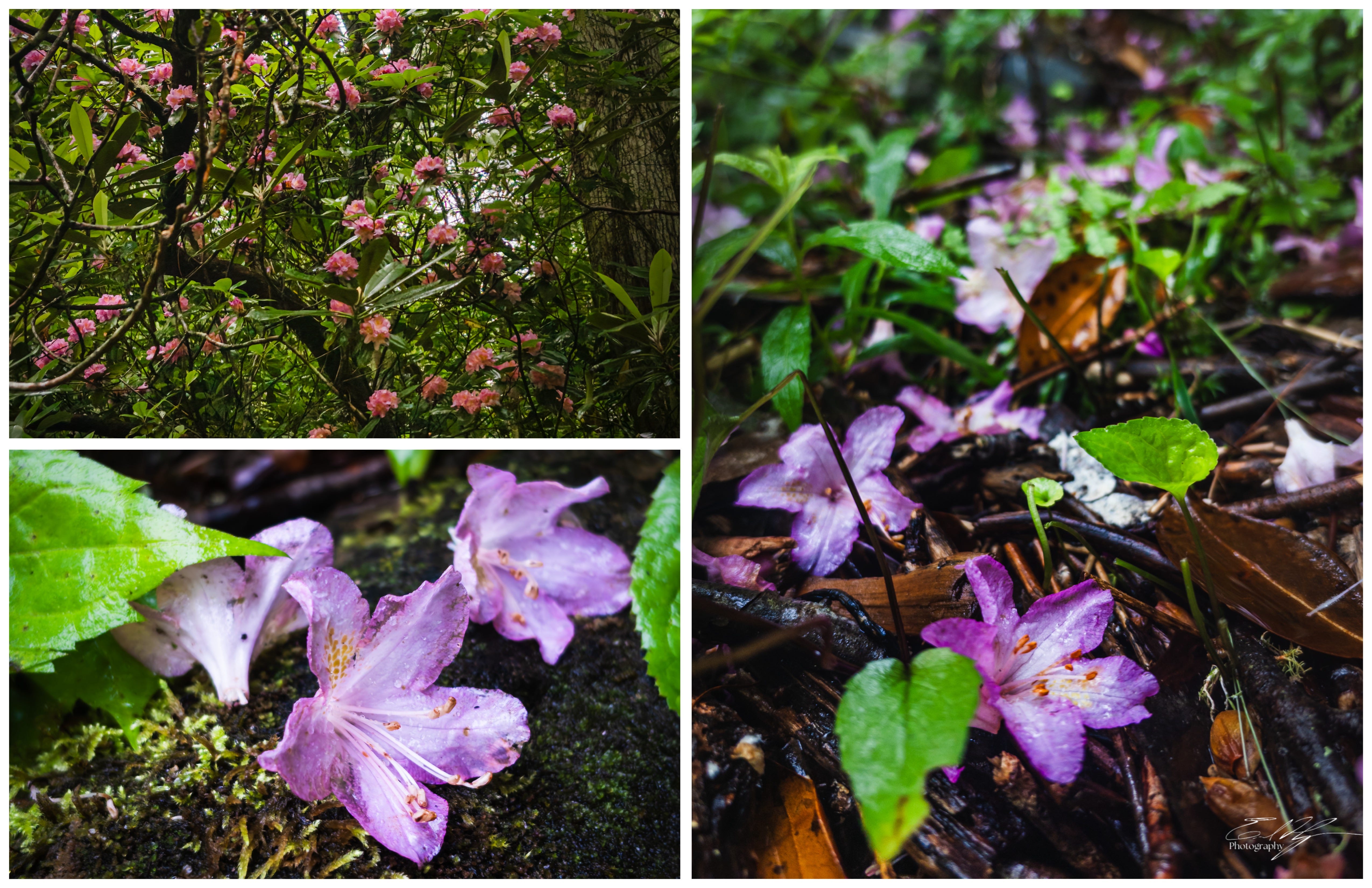
I pick my way further downstream, clambering up and over rock slabs and crevasses. More blooms decorate the forests above. Rhododendron flowers, brilliant among the gnarled limbs and waxy leaves. Discarded purple blossoms litter the ground underfoot.
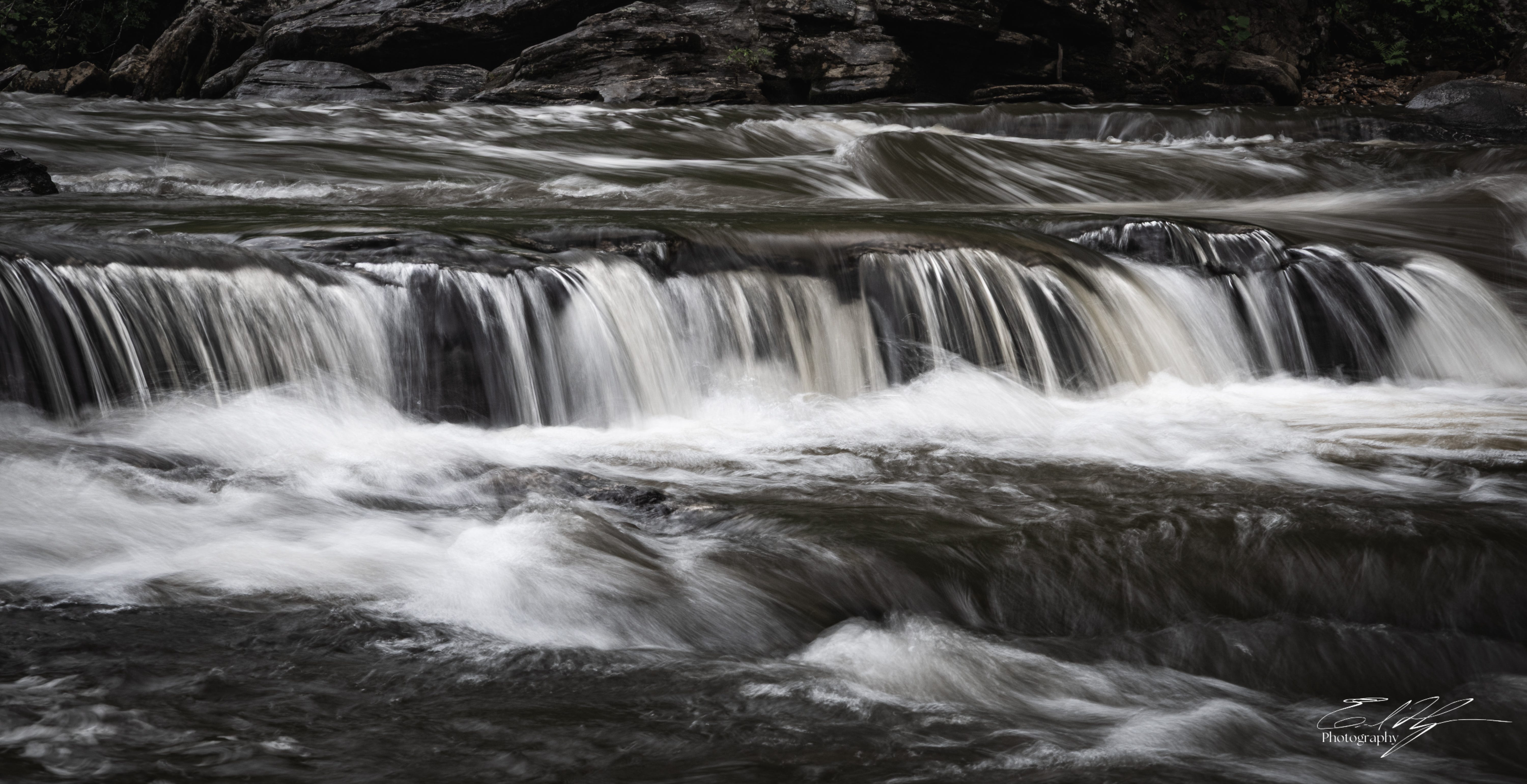
Corkscrew Rapid is the next. This one is difficult to photograph due to proximity and available positioning for the tripod. Although the entire span of it presents challenges, there are many interesting angles and perspectives.
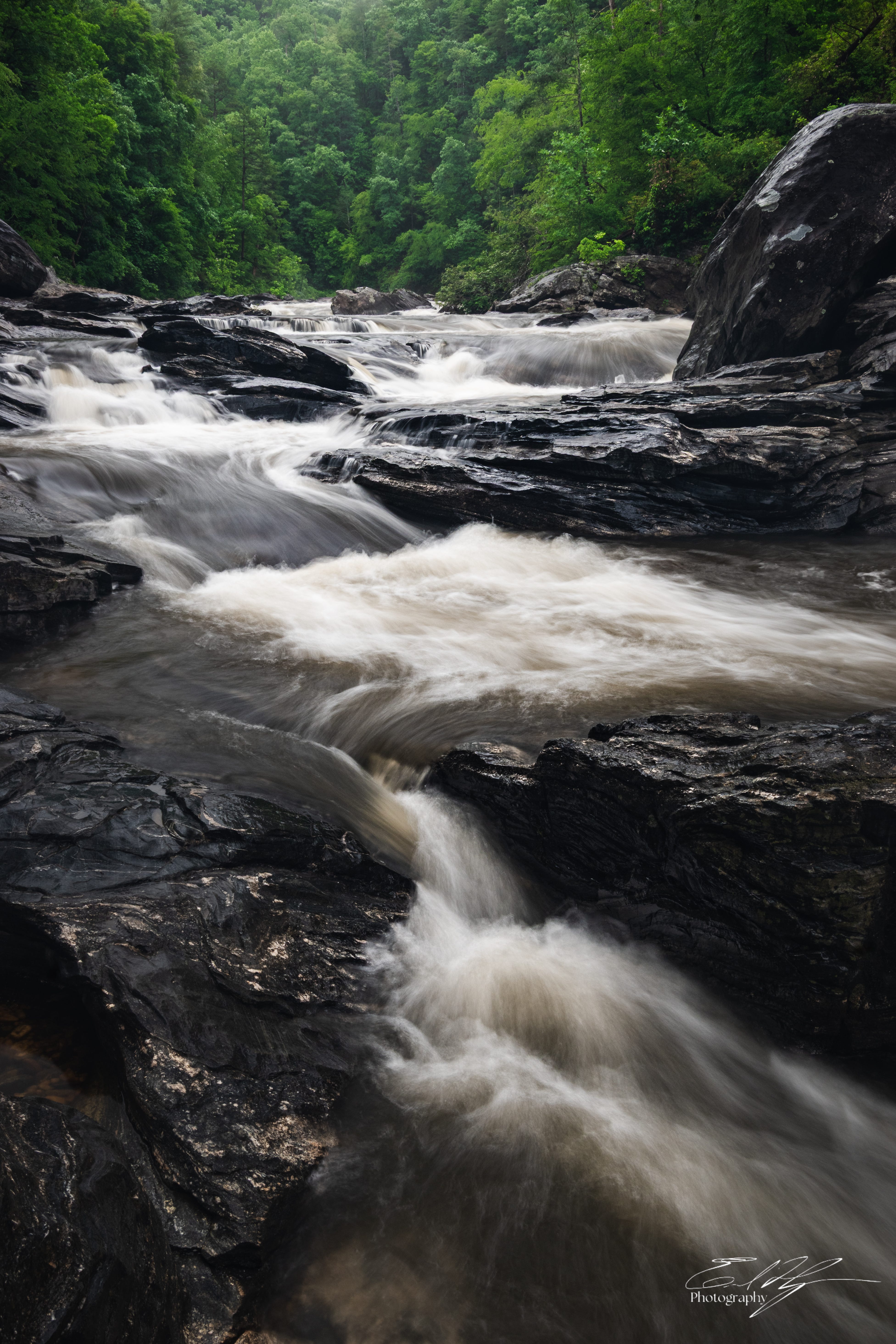
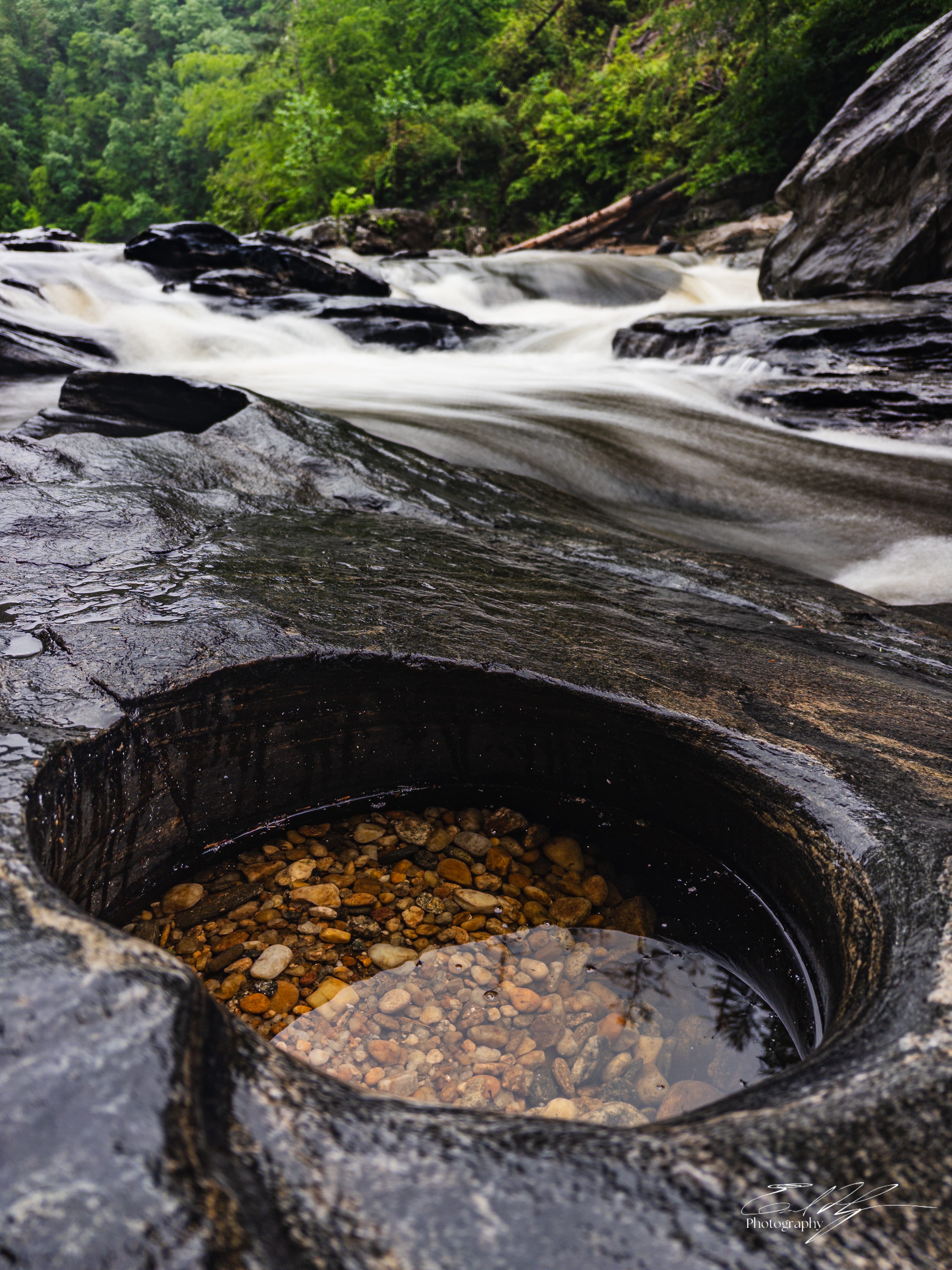
In the middle of a solid slab of rock lies a pothole. It’s curious in its near perfect circularity and holds a small pool of water filled with yellow pebbles. I remember this pothole. I remember trying to photograph it before and having difficulty fitting it and the river behind it in the frame of my widest angle lens. Now I have a different tool. The wide angle of my iPhone camera easily contains these elements.
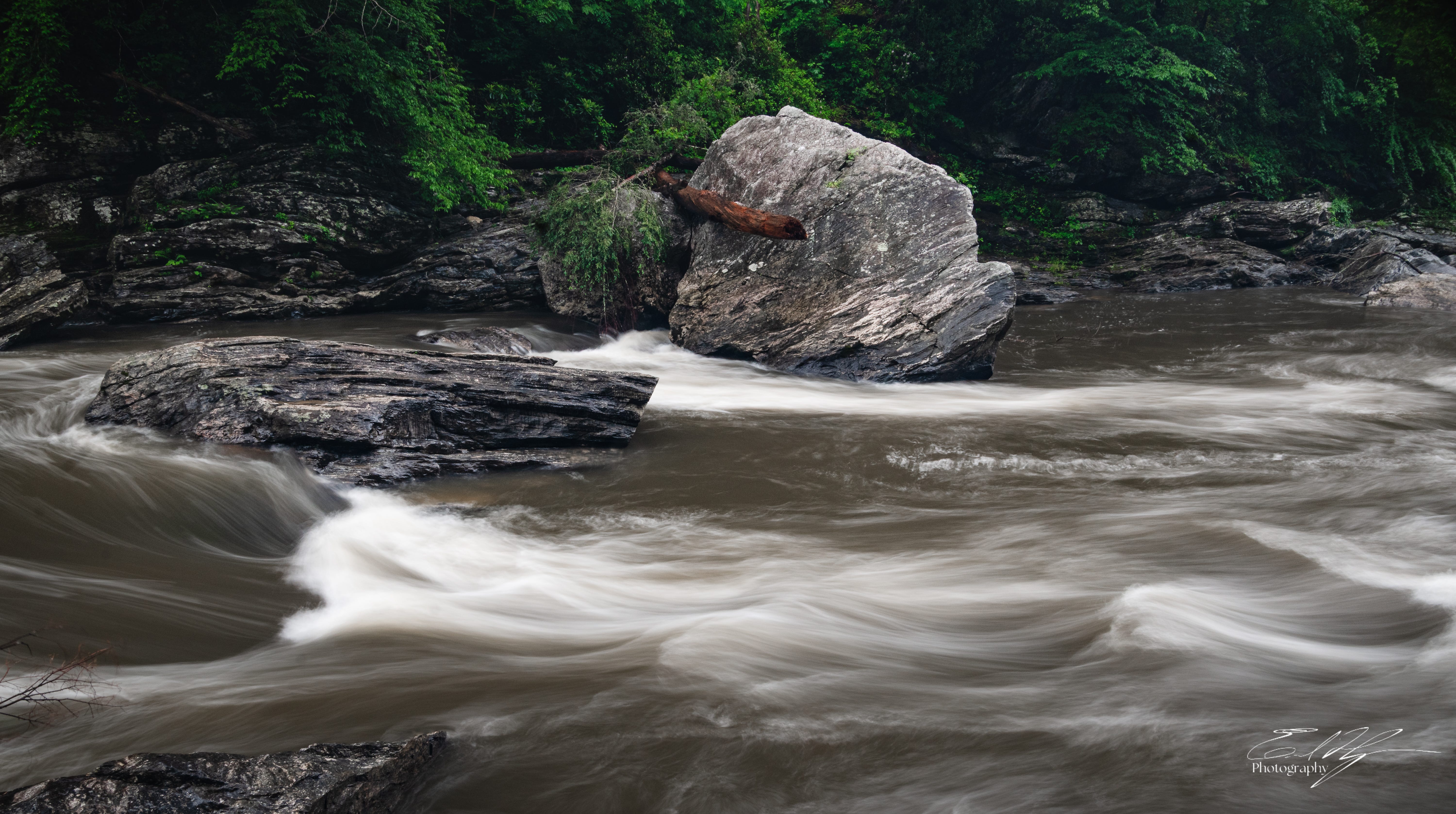
I can see the top of Crack in the Rock Cascade downstream, but my time here is drawing short. Clouds grow darker.
The sound of the tumbling water echoes in my bones. I stand watching the sustained forceful flow. Like the water in a human body, this river has a defined shape within each set of rapids. The water takes its form in the negative space, shaped by the topography of the land, the hardness of stone, and the natural force of gravity that pulls it ever downward. It is the form of what it has to be. Perhaps humans are similarly shaped in the image of nature. The form of what we had to become through evolution, in the negative space offered by the physical laws of the universe and the natural environments we are an intimate part of.
Water evaporates, returns to the source, and then courses through the canyon anew. This is the cyclical process of the natural world, where all is connected and everything, including me, has its vital place. Just so, I know I will return here again. And as this river will one day lose its form as it merges with the wide sea, perhaps a human life leads to a similar merging with the wider scope of the natural world, where all becomes one.
But I hope that day is far off, for I still have rivers and mountains to explore.
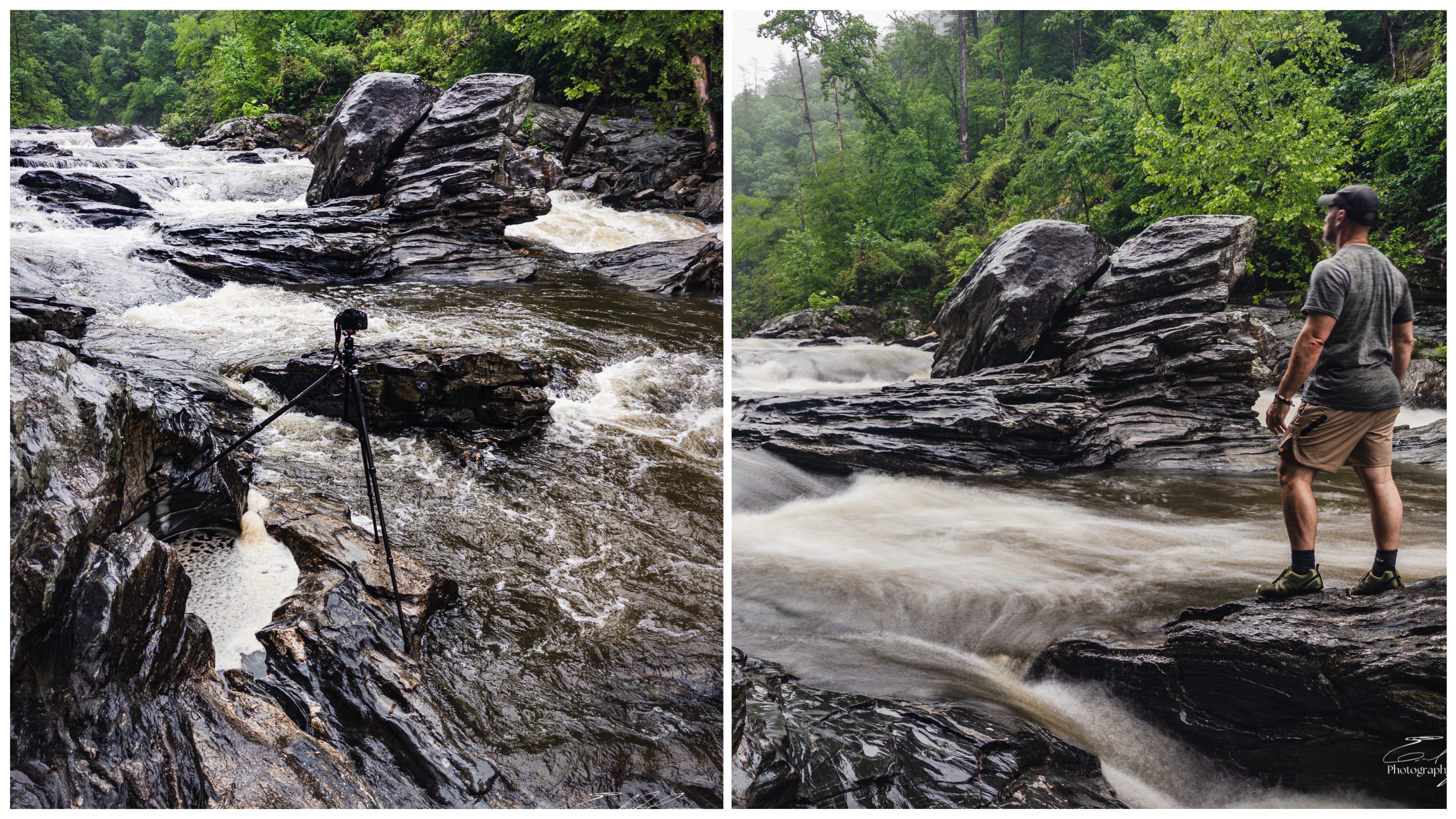
On the return I see my own trail through the plants on the shore as I rock hop my way back. The cliff and its deep pool below present no less of a challenge. With patience, I make it through.
While picking my way past more poison ivy, I look upstream to see a kayaker floating near. He approaches, so I wave. “You ok?” he asks. I reply that I’m doing great, to which he informs me that it wouldn’t be the first time he found a lost hiker while kayaking.
We speak of the canyon he is about to enter and that I just left behind. There is a trail to it, he tells me, on the South Carolina side. It isn’t drawn on any map I’ve seen, but he explains where I can find it. I thank him and he drifts downstream. Behind him come more kayakers and then two rafts full of people wearing white helmets.
I continue on away from where they’re headed, thinking now about another return. Echoes of the rumbling rapids linger in my mind.


I’m stoked to have made it into the Canyon of Five Falls a second time! I hope all of you find it as interesting as I do. If you read my last episode about the canyon, which I re-published a few weeks ago, how do they compare?
Now I’m really interested in finding that trail on the other side of the river! It approaches from the south and on the opposite shore, so entirely new perspectives on the canyon.

If you are enjoying Field Notes, you can support my work in several ways. Share, subscribe, upgrade, tip, or check out my store. Your support goes directly towards the food, supplies, or gear necessary for the photography, writing, and adventures that I share-
Those ferns! Erik, your work inspires me profoundly. I stay in my lane: birds. But I've dabbled with waterfalls, rivers, wet ferns, the like. Seeing what you capture with a camera always reminds me to leave my lane and see what else the natural world has to offer.
My favorite photos from this exciting excursion are Corkscrew Rapids I and the Pothole.
Beautiful words, beautiful images. Nice work!