

Practice
Field Notes IV.VIII: Reflections on honing a craft

Welcome to Field Notes!
* I’m using Substack’s photo grids in this piece because I was too lazy to make single photo collages. If you read this online, no big deal. But if you read it in the Substack app on your phone the photos won’t show up as a grid and, unfortunately, you’ll have to keep scrolling to get through them.

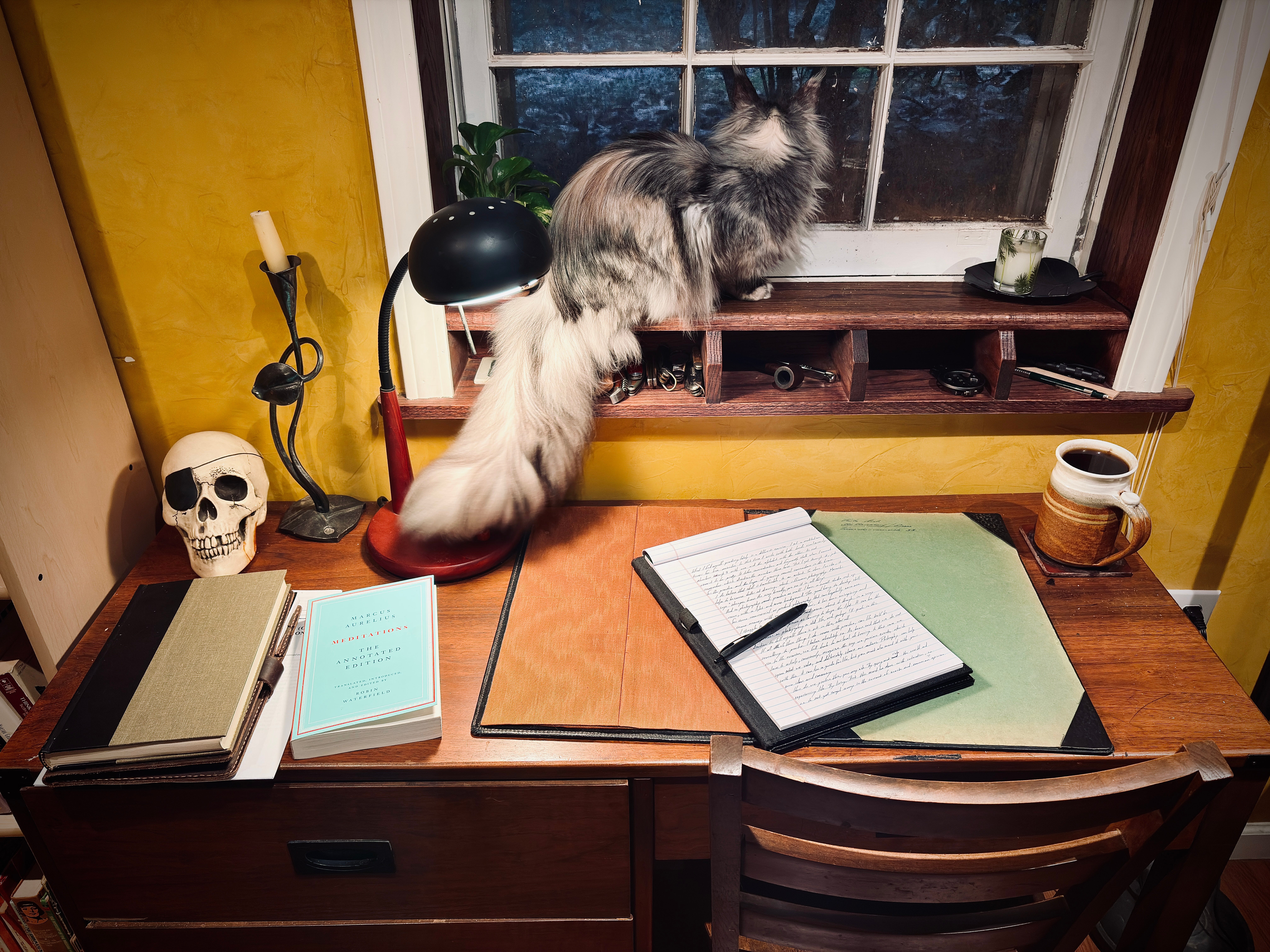
A writing desk is a good place to spend time between adventures. Ernest Hemingway’s advice was solid when he said “In order to write about life you must first live it.” Unfortunately, there are times, as now, when these adventures we live and stories to write about them are sparse.
In these circumstances a window facing wooden desk, pen and pad of paper, and a nearby cat become indispensable companions. They are guides, if you will, to point out the path ahead. You see, sitting down at a writing desk rarely entails spilling a story onto the page with the accidental ease of a tipped glass of water. All of those wisdom pearls that linger opalescent in the mind most often resist being wrapped into neat sentences. So these companions, desk, pen, cat, help facilitate just one thing- practice.
During a recent visit with my Mom at her home, the one I grew up in, I found a small collection of my old journals and sketchbooks. Entries 25 years past; some even older. Those passages describe a different lifetime. My own hand wrote them, certainly, but perhaps it was a different person, even so. I was struck by just how much writing and drawing I did back then. All types of sketches, attempts at poetry. Is that what life was like before smartphones?
Much of that practice fell off in the gap between then and now. Drowned out by the beautiful pandemonium of raising two kids. Or it just dissipated, along with the decade I lost working night shift. It was all good practice, though. And maybe it is aiding me after all this time, now that I have some experience of a lived life to write about.
Mom tells a legend about my youth, from beyond the reach of my own memory. At a very young age I showed an inclination to be left handed. It may have been an bias of that generation or perhaps my mother’s Old World disposition, but she believed my life would be much easier being right handed. I mean… where would one even find left handed scissors? So she trained me to use utensils and toys right handed. That must have taken some practice! It worked, though, because all of my adult life I’ve been right handed. Mostly.
During the time frame of some of these old journal entries I had learned that hand dominance affects the area of the brain you use. And this, in turn, affects things like logical reasoning vs artistic expression. Not wanting to leave any potential untapped, for a long time I wrote left handed, with all of the awkward practice that involves.
I am well aware that my normal handwriting is distinctive. Sharp and strongly slanted to the right. Someone analyzing that may whisper with eyes wide about possible psychopathic tendencies. It wouldn’t surprise me. What is interesting is that when I write left handed the script looks very similar, just slanted in the opposite direction. That could be a metaphor for something that only my cat really understands.
Left handed writing is no longer something I train. Too cumbersome. Too time consuming. I’ve now found a different practice. With a meditation timer set to five minutes, I write with both hands simultaneously. Numbers 1 through 9 with one hand and the alphabet with the other. It’s not meant to be pretty, not about learning ambidexterity. There is concentration involved, and it stalls when I cannot remember which direction the number three faces. The point? Its hopefully to forge new neural connections in the brain. It is practice.
Once the ritual is complete, the words can then tumble out. Letters falling like so many seeds strewn across the page. Ready for the sifting. The constant winnowing of ideas.


I do believe that skill is transferable. Not exactly the specific fine motor pathways of specialized competencies. Those skills still need to be honed through practice. But there is a deeper level to skill building. As Miyamoto Musashi says- “if you know the way broadly you see it in everything.”
So, there is something about practicing writing that helps me become better at drawing. And the drawing hones the eye for photography, and so forth. Consider now, that this concept even escapes the bounds of the creative realm.
Shooting a gun is a skill that demands a lot of practice. Dry fire practice, daily. The firing range as often as possible. And the tactics of slowly and deliberately clearing a structure with a small team. It is not sexy work. But it is a fundamental skill upon which all else is built. All of this demands unending practice, yet it is an obligation of trust demanded by any profession of arms. You do not rise to the occasion, it is said, but fall back to the level of your training. This might seem grim, but these skills ensue from the appeal of justice and of love for humanity at large.
The stroke of a pen, a camera shutter release, the click of a trigger. Each practice influences the other. The mind that judges and acts in each instance is the same.

Photography is, of course, another skill that requires practice. After six years of dedicated skill building, I feel modestly proficient at seeing light in natural settings. What the light offers and what may not work in an image. How weather conditions or time of day will affect the light. Now I’m trying something a bit different.
In an attempt to maybe, possibly, hopefully one day be able to earn some money with my camera, I am exploring commercial or product photography. And for that, I am using artificial light in a studio setting. That is entirely new to me. Honestly, motivation for it has been low. But I can console myself with the idea that these same skills may be used for artistic still life or fine art photos in the future.
To accomplish this I need practice. So, based on an essay by Don Giannatti, I did just that. It involved a fixed light source and fixed camera position. The subject, a piece of fruit or some mushrooms, are then placed at four inch intervals away from the light. The point is just to learn how the light embraces the subject at each distance.
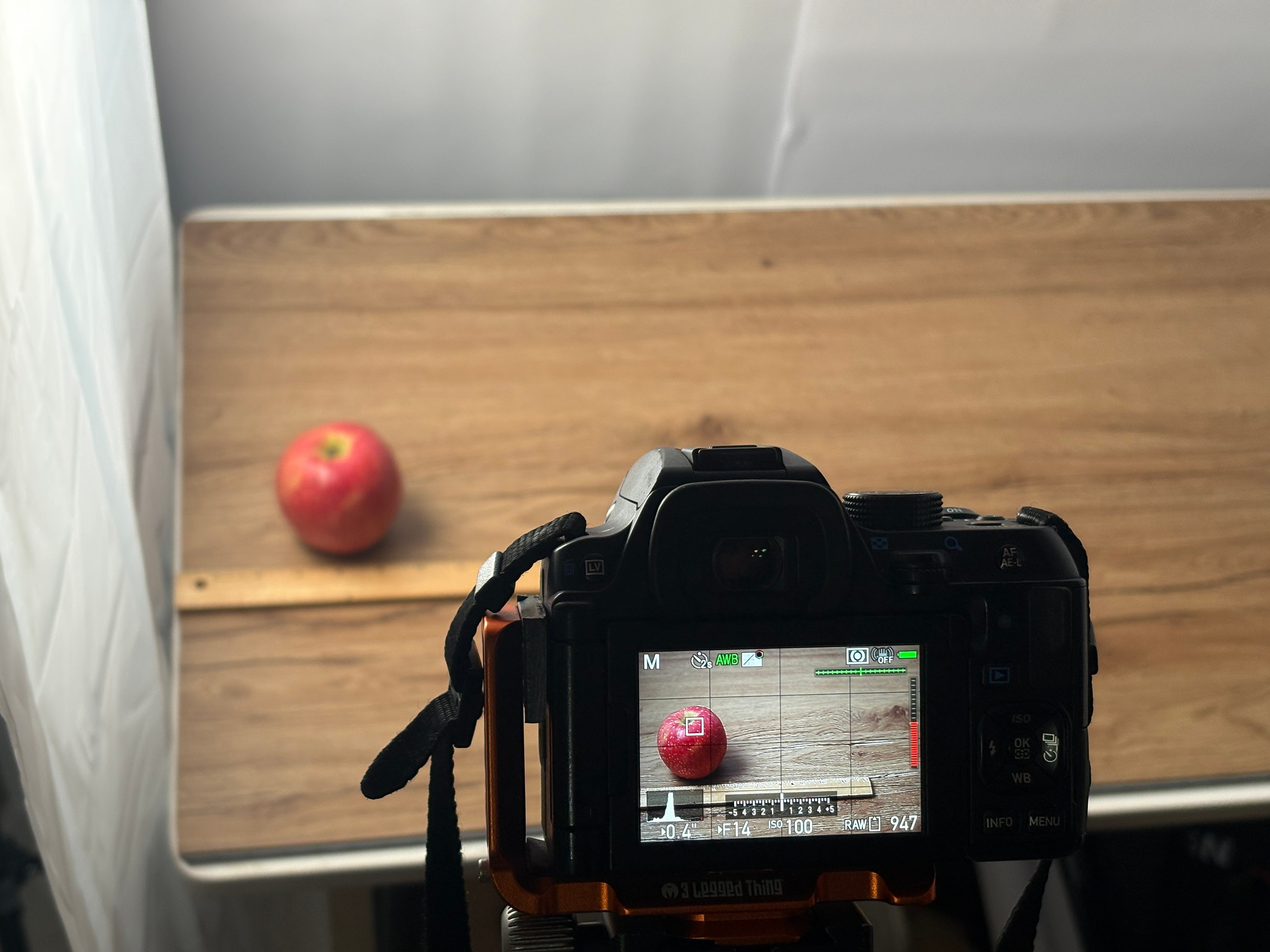


After this, the same skill is repeated. But, at each distance, a white panel to bounce the light is placed on the opposite side of the subject at receding intervals of four inches. Again, it is simply a study of light.
This is not exciting. Not sexy artistic work at all. But it is skill building and I can bring all of my other experience to bear, knowing that the investment in this practice will benefit me broadly.


With a broadened perspective on practice and skill building, let us look further. Can we consider life itself as a skill that requires practice? Philosophy tells us it is, and I agree.
How would one go about practicing the skill of living? Just by going out into the world and seeking experiences. Perhaps just a walk across town. But we must do this authentically and deliberately, focused clearly on what we value and why, how we frame the events that happen, what actions we take. Whether they are dramatic occurrences or small, intimate moments, all of these experiences provide the opportunity to practice being the best possible versions of ourselves.
We are all inherently capable of fulfilling the highest of human potential, but it takes deliberate work to get there. However, the idea of arriving at this goal is likely a mirage. But that just means that life is an endless pursuit of excellence.
Someone said “when the muse comes I want her to find me working.” Was that Steven Pressfield in The War of Art? Or maybe it was Picasso? Either way, I’m sitting at my writing desk to put pen to paper with my cat by my side. For practice.


What are you practicing? Or, as Lou Tamposi writes, what are you training for?

Training vs Practice. Is there a distinction? If so, where? I want to know!

If you are enjoying Field Notes, you can support my work in several ways. Share, subscribe, upgrade, tip, or check out my store. Your support goes directly towards the food, supplies, or gear necessary for the photography, writing, and adventures that I share-
First of all, your desk set up is awesome.
Second, this is the second time I’ve come across someone who can write with both hands simultaneously. In grad school, a patient of mine was one of the richest men in UK. He came to the Cleveland Clinic to get hearing aids. He noticed I was left handed and I told the short story of how my grandfather believed I should have my hand tied behind my back to learn correctly with my right. While my parents didn’t allow it, my patient explained that is exactly what happened to his father in grade school. His father, however, continued to write with his left hand at home while the nuns didn’t allow it in the classroom. Before he knew it, he could write with both hands, perfect cursive, different words. His father would write letters this way as it took him half the time! It is a skill I’ve occasionally practiced but am no where close to proficient.
Your practice of numbers with one hand and letters with the other is brilliant! One I’m going to start trying!
Another outstanding post brother.
My favorite writer EB White, sitting in his little spare writing shed overlooking the bay near his Maine farm, would approve of your setup, Erik!
“You do not rise to the occasion, it is said, but fall back to the level of your training”, is profoundly true. The virtue of “arete” as the pursuit of excellence by diligent practice is for me one of the best prescriptions for an interesting and productive life.